Monday, November 29, 2010

Stolen Memories

Hello again! I hope everyone has had a fantastic Thanksgiving. I just spent mine in New York with my grandparents, where we watched James Bond movies, had a huge Thanksgiving dinner, and got to see La Cage Aux Folles performed live on Broadway. Naturally, I also went birdwatching. Two things I was very lucky to see were a Fork-Tailed Flycatcher (a crazy looking thing that somehow wandered in from South America) and a Little Gull (another rarity that I've only seen once before).

Minus the birds, pumpkin pie, and crazy New York people, I also spent a good chunk of time reading Reading Lolita in Tehran for English class. Although the book so far is a great read, one passage in particular stood out as blog material. Here, Azar Nafisi describes how the loss of basic freedoms in her country has affected each generation of people:

"My generation complained of a loss, the void in our lives that was created when our past was stolen from us...Yet we had a past to compare with the present; we had memories and images of what had been taken away. But my [students]...had no past. Their memory was of a half-articulated desire, something they never had." (76)

Now you may ask, "what does this have to do with nature and the environment?". The answer is written in the creed of each and every environmental organization. Why conserve the environment? Why save the whales, the trees, or the pandas? It's always about future generations. We want our children and great grandchildren to witness the planet's natural heritage, just as we want them to witness freedom. And when there are no more whales, trees, or pandas remaining, what are our children left with? An empty void- just like what Nafisi describes.

After learning about some majestic bygone creatures like the elephant bird, Tasmanian Tiger, Great Auk, wooly mammoth, and Dodo, I think we all feel a degree of loss and hopelessness. Like Teddy Roosevelt once said: "When I hear of the destruction of a species, I feel just as if all the works of some great writer have perished."

When you think back to what the world was like before it became despoiled by mankind, it's almost unfathomable. Less than two centuries ago- in the very region I now live in- bison swarmed across in enormous herds, and passenger pigeons literally blackened the skies. Yes- literally. According to historical accounts, a SINGLE flock of passenger pigeons could be 300 miles long, a mile wide, and take SIX DAYS to migrate overhead. A friend of mine- who happens to be writing a book on passenger pigeons- told me how the birds would strip trees of their branches just by landing in them and the beating of their wings would create downdrafts as they took off.

Even after witnessing extraordinary numbers of birds, I cannot imagine anything like this. Passenger pigeons were slaughtered by the thousands and eventually hunted to extinction. The last bird died in 1914, and like Nafisi's students, we have no tangible memories left of them- only stories from a distant past.

Monday, November 15, 2010

The Big Picture (Last Poisonwood post)

A week or two ago, I finally finished reading the Poisonwood Bible. Excellent book. Aside from possessing symbolic actions, vivid descriptions, five intriguing characters, and a well-developed plot, the story offers several vital messages near its end.
One message that struck me in particular came from Adah. As a medical student who quit her profession on moral grounds ("stealing life out of nature's jaws"), she provides an intriguing view of where humans fit into the world.

"In the world, the carrying capacity for humans is limited..." she says. "When Albert Schweitzer walked into the jungle...he meant to save every child, thinking Africa would then learn how to have fewer children. But when families have spent a million years making nine in hopes of saving one, they cannot stop making nine. Culture is a slingshot moved by the force of its past. When the strap lets go, what flies forward will not be family planning, but the small, hard head of a child. Overpopulation has deforested three quarters of Africa, yielding drought, famine, and the probable extinction of all animals most beloved by children and zoos. The competition for resources intensifies, and burgeoning tribes itch to kill each other. For every life saved by vaccination or food relief, one is lost to starvation or war." (528)

This notion that Adah speaks of (overpopulation) is nothing new- as scientists, humanitarians, and family planning services have been addressing it since the 1960's. But as the human population is expected to reach 10 billion in the next decade, this is truly a cause for concern. If you think about it- it's overpopulation that poses the greatest threat to the planet. Climate change, competition for resources, widespread starvation, pandemics, and disruption of ecosystems owe their existence to exploding human numbers.

When the population of a certain organism explodes, nature tends to react with one or more control mechanisms. A large herbivore population may be kept in check by predators, disease, or a limit in food abundance. These are, in a sense, the "laws of nature".

The overpopulation that we face today is not occuring because certain families decide to have nine children instead of one. Rather, it's happening because we lack natural control mechanisms. We've eliminated large numbers of diseases, destroyed all or most animal competition, created nearly limitless food supplies, and thus multiplied our numbers.

Another important fact to note is that we've always had, and always will have plenty of kids. This is what Adah was getting at. Our desire to reproduce is driven by an ever-present genetic instinct. Whether we like it or not, this instinct is always with us. An individual who doesn't wish to reproduce will contribute nothing to the gene pool, whereas the family with nine kids may end up with nine additional offspring for each child.

As of now, it seems as though there is little hope of solving overpopulation without taking drastic measures (ie, cannibalism). Before any action can be taken, however, one major question must be addressed: Are humans really above the laws of nature?

According to Adah, we are far from it. As proven by the Black Death, overcrowded cities and long-distance networks create perfect conditions for the spread of disease. As Adah herself said, "Air travel, roads, cities, prostitution, and the congregation of people for efficient commerce- these are gifts of godspeed to the virus". So perhaps a new strain of disease- one that does not respond to known cures- will end the human stranglehold on the planet. It's not entirely impossible. AIDS, as you know, is a very recent epidemic. And as of now, an entire order of animals may be in the process of extinction. Frogs and ampibians all over the world are believed to be dying from chytrid fungus- a disease that was discovered less than 20 years ago. "What does this have to with humanity?" you may ask. Well, my friend- WE humans could be next.

Also, please save the frogs.

Thursday, November 4, 2010

Word of the Day: Anomaly

Anomaly [uh-nom-uh-lee]. A deviation from the common rule, type, arrangement, or form. An incongruity or inconsistency. It's almost as if someone took the big, chunky word "abnormality" and condensed it until it became smooth and polished.

But I believe "anomaly" describes more than just an abnormality. It describes something curious and unusual rather than an simple glitch in the world's structure. The way the syllables flow, you would think it's some kind of flower or name for a person. But it's not- and the world as we know it is filled with anomalies.
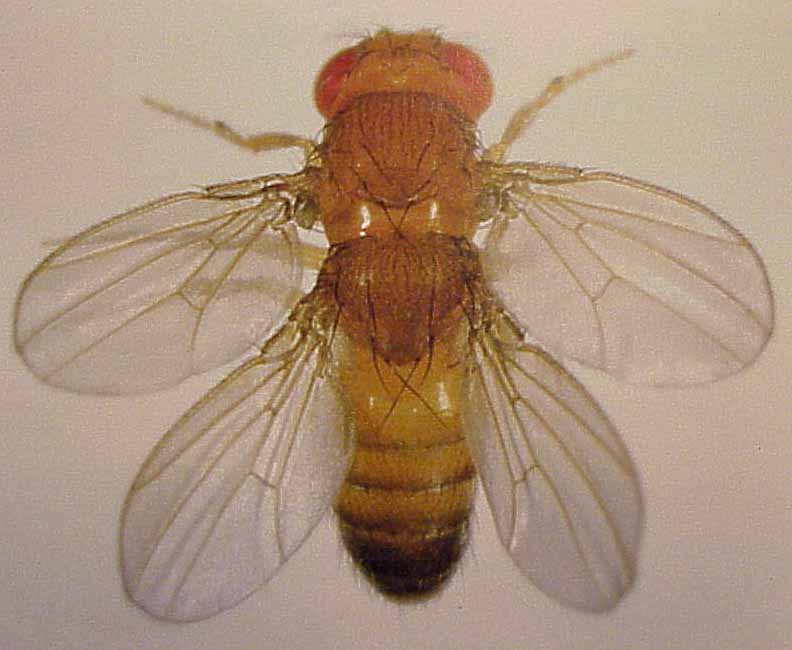
The freakish-looking fruit fly in this picture provides just one example. Its strange condition was caused by a random genetic glitch- or in other words, an anomaly.

In addition to fruit flies, siamese twins, and 4-legged ducks that make the news, nature is filled with plenty of smaller, everyday anomalies. This bird that I photographed a few summers ago is a leucistic Robin, which lacks pigment in certain feathers due to a mutation.
The character Adah from the Poisonwood Bible is also somewhat of an anomaly- not just physically- but in the way she thinks. She rarely speaks, spontaneously thinks up palindromes, and in many ways, stands out from the other members of her family.

The fact that I slept in until 8 today may have also been an anomaly (although it could have been that I just didn't set my alarm clock).