Sunday, May 8, 2011

The Final Post (for now)

Hello everyone!


It seems as though spring has finally caught up! As the school year begins to wind down, the trees are full bloom, and the forests are once more echoing with birdsong. In many ways, this season is a blessing, but it can also be a curse, since its beauty is so short-lived. By the end of the month, all the tulips and trilliums will be dying, temperatures will be getting hot, and most of those lovely warblers will have headed somewhere further north. So for now, I've been enjoying spring while it lasts- the birds, flowers, weather, and everything.


Since this is the last post I'll be writing for the school year, I thought I would write about some sort of "big picture" where I draw from everything that I learned this past year and throw it together into one big statement.


However, I think that's kind of trite. Instead, I'll tell a more specific story.

Today, after an exciting bird-adventure at the Grove (Glenview), I decided to relax at home and study outdoors for my AP Bio Test. No sooner had I sat down in my favorite lawn chair, than a Black-and-White Warbler appeared.

Although this bird is hardly uncommon in May, it's got some unique qualities. Unlike other warblers, which flit from branch to branch, this bird creeps sideways along tree trunks, forages upside down, and likes to poke around in every nook and cranny it can find. Now consider its plumage- an assortment of black and white stripes- and it looks like a zany, tree-climbing zebra.
So I put down my homework and decided to watch this little wonder creeping around the trees in my backyard. He seemed a little wary of me, but couldn't have cared too much since he landed in my backyard pond to take a drink. At this point, however, another bird appeared- entirely golden-yellow with red streaks on the chest. It was a Yellow Warbler, and it too, had come down to drink from the pond.

After admiring the birds for a short while, I decided to get back to work. But just as I opened my textbook, two more warblers appeared. These were Black-Throated Green Warblers- birds that I lovingly refer to as "Blackbeards". I try studying again. Another Black-and-White Warbler shows up. Then two plump little yellow sprites: Nashville Warblers. A beautiful Magnolia Warbler appears. Then a Cape May Warbler. Three Yellow-Rumped Warblers. The trees and bushes are now dripping with them- shades of yellow, black, blue-gray, and orange. And then there's a tiny bluish bird with a fiery, liquid-sunshine pattern blazing across its chest. It's a Northern Parula- one of the rarer ones. As it pauses in a Japanese Maple, the sunlight dances upon its colors. And then, just as quickly as it appeared, it is gone. In any case, these birds were simply passing through. For them, my backyard is little more than a stopping point on their yearly journey from Canada to Central America. The stopover, however, is essential, for it is difficult for a 0.4-ounce to fly over 2,000 miles in a single month. For each and every day of migration, these birds must stock up on food, and for each and every night, they must fly.


As I grow, learn, and graduate high school in the coming month, I feel as though I am completing another step of my own personal journey. Like the blossoming trees that provide migrating birds with sustanence, the Academy has done a great job in providing me with all the skills that I'll need as an adult. And even if Senior Academy English is just a small part of the migratory route, I feel that it has done me very well. In this year of English, I've flown through times good and bad, developed deeper levels of understanding, and learned some new things about myself along the way. And like the Parula, I am ready for the next leg of migration.

Tuesday, April 19, 2011

What's the Deal with Wolves???

Just over a week ago- April 8, to be precise- a rider was introduced into Federal Budget Bill that would remove gray wolves the Endangered Species List in 5 western states. Although Congress has previously intervened with a number of wildlife matters, this occasion marks the first time in history in which Congress has single-handedly "delisted" a species.


So what's the deal here??? Is this a "legit" delisiting for species that has recovered? Or is this the work of some angry ranchers flipping shits about wolves and sheep? Unfortunately, there seems to be almost no clear answer. Wolf conservation remains one of the most controversial wildlife topics in our country's history, with heavy bias on both sides of the argument. While conservationists and wolf-lovers across the nation have vied for the protection of these magnificent animals, the people who actually deal with wolves on a day-to-day basis have repeatedly argued that wolves pose threats to their livestock.


But before we begin to address that, let's ask ourselves: What exactly is the status of the Gray Wolf? Despite centuries of persecution by man, wolves remain widespread on a global scale- ranging across Canada, Central Asia, Siberia, and some of the less densely populated areas of Europe. Still, just by looking at the map, it's shocking to see how much territory they've lost in North America. Whereas wolves may have once roamed as far as Mexico, it seems that their only remaining strongholds are the Upper Great Lakes and two isolated pockets out west.


The fact that there are ANY wolves remaining in the Lower 48 is largely due to intense conservation efforts and reintroduction programs. Just 15 years ago, a few Canadian wolves were brought to Yellowstone National Park, and since then, they have made a dramatic recovery (from 66 individuals to 1,651). The same goes for the Wisconsin and Minnesota, where legal protection has allowed wolf populations to skyrocket.


According to state senators and wildlife officials, the wolf populations have risen well beyond expectations and have reached the point where they are spreading into human-occupied areas, feeding on livestock, and causing trouble for local farmers and pet owners. Aside from taking a few sheep or cattle every now and then, people- particularly hunters- are worried about the wolves' impact on elk and deer populations.


The latter view, however, is controversial for a number of reasons.
First of all, it's hard to determine just HOW many elk the wolves are taking. Studies on this matter are few and far between, and without proper research, its nearly impossible to determine whether wolves should be held responsible for declines in deer and elk populations. According to studies by the International Wolf Center, a single wolf may consume between 14 and 19 deer-sized game animals per year. Multiply that by few thousand and it would seem like that's alot of kills, but in truth, this is NOTHING compared to the number of the deer and elk that starve, collide with vehicles, or are taken by hunters every year. By keeping deer and elk populations in check, wolves actually do alot of good by preventing them from overgrazing and outstripping their food supply.


Unfortunately, it seems like the recent delisting of wolves was more of a political move than something that was actually backed by scientific evidence. Although 1,651 may sound like a huge number of wolves, it's really nothing if you consider the fact that this is the entire American West we're talking about. That number could plummet just as fast as it went up, so perhaps Congress needs to think things through before they allow something like this to pass.

Tuesday, April 12, 2011

Interpreting Nature


For the past two weeks in my English class, there's been alot of reading and classwork on nature- specifically, the portrayal of nature in literature. What is typical of the images we associate with nature? Streams? Mountains? Thunderstorms? Untouched wilderness? Or perhaps parks and gardens? Any way you look at it, it seems as though nature is open to an enormous range of human interpretation. At one end of the spectrum, there's nature as a source of harmony, beauty, perfection, and tranquility. The sound of a forest waking with birdsong, the complexity of a flower, and the intricate balance of life are just a few of the many phenomena that provide humanity with this perspective. On the complete contrary, we may view nature as a cruel, powerful, unforgiving force that has waged battle against mankind through the ages. Every day, nature assaults us with storms, earthquakes, famine, and disease. Thus, we're constantly developing new ways of fighting back, conquering nature, and taming it so that we may harness its great and terrible energy.

So with this in mind, what is nature? Friend? Foe? Neither? Both? As humans, do we consider nature to be wild, savage, and untamed, or do we call it our sanctuary? Following a discussion from class, it seems that people's interpretations of nature vary depending on their geographic region, local culture, age, class, religion, and even gender.

Let's take a young child for example. A child who regularly interacts with nature may see the natural world as a place of mystery, adventure, and freedom- far removed from the boring world of adults. According to E.O Wilson is his book titled Biophilia, a large number of children go through a "nature phase", where they venture out into the natural world, explore, investigate, and make their own discoveries based on observation.

Interestingly enough, the way children approach nature is very similar to biologists of various fields. Like children, biologists are curious, fascinated by natural processes, and enamored with the idea of discovering something new.

Let us also not forget that people's views of nature may vary depending on their generation or time period in which they lived. Before cars, communications, or modern industry, nature was much more of a force to be reckoned with, and less of something that needed "saving". Aside for a few budding conservationists such as John Muir, Theodore Roosevelt, and Henry David Thoreau, who insisted on preserving nature and biodiversity, there was little incentive to protect anything until the 1960's, when the environmental movement kicked off.

So in any case, what are your views of nature?

Monday, April 11, 2011

Update

Hello everyone! In case you haven't noticed you've noticed, it's been a while since I last wrote a post. To be honest, I've been pretty busy with homework and college decisions, but hopefully, things will work themselves out and I'll get back to doing my regular posts. So before I begin with another topic, I'll fill you in on what's been going on in my life lately.

  • Aside from online consumer homework, a visit to Lawrence University, and a bit of birding here and there, I did relatively little over the course of spring break.

  • I GOT ACCEPTED INTO CORNELL UNIVERSITY!!! (A place I'll be visiting on my own this week)

  • While I was visiting Lawrence up in Appleton, I did some local birding and stumbled across YET ANOTHER BOHEMIAN WAXWING!!! Unlike last time however, the bird actually stayed put and provided my entire family with excellent looks.

  • I just tested out my first homemade bird blind: a large cardboard box with 2 holes just big enough for a camera lens. Although the birds and animals don't seem to mind being followed and photographed by a man in a giant box, I'm pretty sure that I weirded out the neighbors.

  • Last but not least- it looks like spring's finally coming here to stay! With Sunday's warm spell, all the plants are coming up, the grass is green once more, tree are budding, and the daffodils are in bloom!

Monday, March 14, 2011

A Weekend Escape- Part 2 (The Mound Builders!)

So in any case, that's not the end of my adventures from this weekend. In between viewing the giant snow goose flock at Emiquon, trying to photograph ducks from a moving car, and chasing Eurasian Tree Sparrows, mom and I decided to stop by the Dickson Mounds Museum.

I must admit, I didn't really know much about Dickson Mounds prior to visiting. All I really knew beforehand was that it consisted of some old Native American burial grounds, which were built hundreds of years ago, forgotten, and later discovered by a man named Dickson.

In 1927, after purchasing a tract of land along the Illinois River, Dr. Don F. Dickson just so happened to stumble upon a series of burial mounds from an ancient Native American society. He soon began excavating, but instead of removing the bones and other artifacts from their graves, he left them intact, transforming the place into a private museum of sorts. Tourists, scholars, and archeologists came from all over the world to interpret Dickson's findings, and eventually, by 1945, Dickson sold his museum to the state of Illinois, which has maintained it ever since.

So, yeah... I kind of learned this from browsing the Dickson Mounds website, but one thing that I almost certainly had no prior knowledge of was the society that actually built the mounds.

When we picture Native Americans, we tend to think of them as nomadic hunter-gathers who lived in tribal communities, worshipped nature, occaisionally went to war with other tribes, and were eventually destroyed by the Europeans. And while we do acknowledge that the Native Americans were here "first", we rarely seem to take their 10,000-year history into account- from the crossing of the Bering Land Bridge up to the present day. While our textbooks may have entire chapters devoted to ancient Egyptian society, the sections describing Native American history seem consistently vague about the societies, languages, and religious beliefs that evolved during that enormous span of time. It's almost as if there's a giant, 10,000-year gap in history...but why?

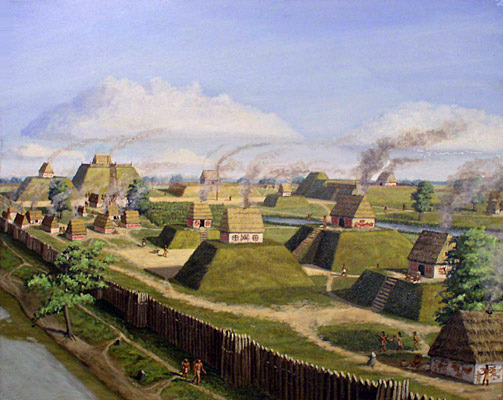
I know for one thing that the North American Indians never really "built" much in comparison to other native societies, such as the Aztecs and Incas. There are no great big temples of stone in New Jersey, and certainly not in Nebraska, but there are these burial mounds in some parts of the midwest. Dickson Mounds is one of these places, and contrary to what I've always believed about Illinois history (that it hardly dates back further than the 1800's), native "mound-building peoples" had actually built thriving, sedentary societies as early as the 11th century- complete with temples, walled cities, population centers and trade-based economies!

According archaeologists at the museum, these Mississippian societies flourished during the first half of the millenia, but eventually fell into decline as they went to war with each other and contracted diseases. When Europeans colonized Illinois, most of the mound-builders had already evicted, and for the few that still remained, European conquest dealt the final blow.

I find it disappointing that we hardly spend any time learning about the ancient cultures of our region- and even worse how we rarely imagine them as little more than primitive, nature-worshipping teepee-dwellers. I glanced over my World History textbook from freshman year and noticed that the mound-builders are only mentioned in a single paragraph. I mean- really, what's the deal? Why don't we learn more about them?

In a sense, it all boils down to New Historicism- the idea that all writing is a product of its time. The Europeans who encountered native societies in all their intact glory found them inferior. When they initially encountered the remnants of mound-building societies, they actually refused to believe that the mounds were built by Native Americans. They didn't believe that such primitive, inferior people were "capable" of building these things. And since the Europeans were the ones who eventually wiped out the native populations, their writings- which offer us a glimpse into intact native societies- were probably biased to the point of being innaccurate.

A Weekend Escape- Part 1

This weekend, my mom and I took a short vacation to Fulton County, Illinois- mostly in search of our favorite birds: Ducks. With the ice melting, rivers swelling, and fields beginning to flood, the waterfowl -which have spent most of the winter in ice-free zones- are now heading north. Nowhere is their migration more evident than along Illinois' major rivers, where these ducks stop to rest and refuel before continuing their journey.

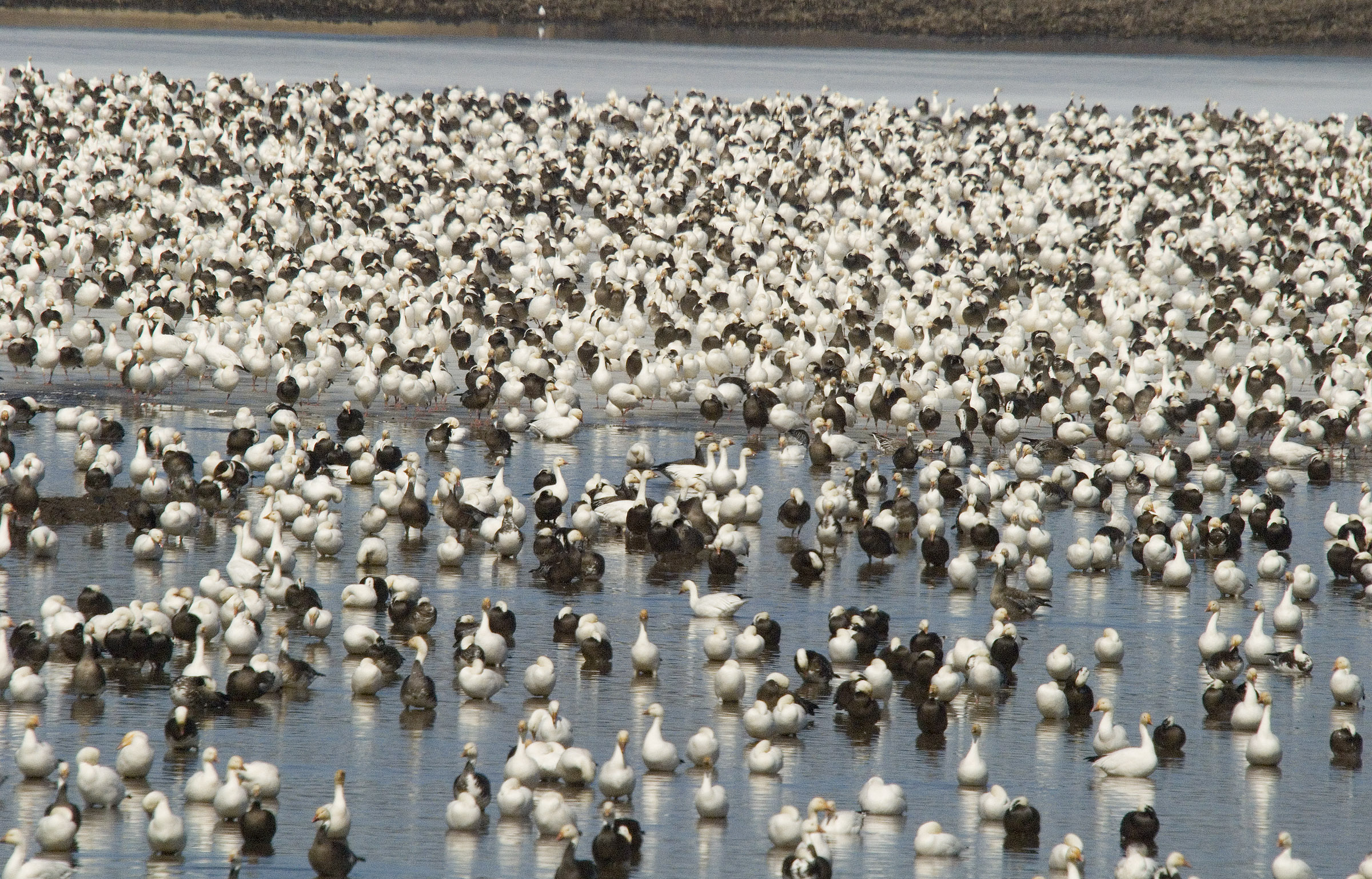
At Emiquon National Wildlife Refuge, a shallow, 2,000 acre lake formed at the junction of the Illinois and Spoon Rivers, snow geese often gather in the tens of thousands, accompanied by pelicans, bald eagles, and thousands of other ducks and waterbirds. Interestingly enough, this wildlife magnet hardly existed before the Nature Conservancy purchased it in the year 2000 (none of my old bird books on Illinois mention it). Although the area had historically been a giant wetland, years of intensive farming operations had all but drained the surrounding marshes and confined the the Illinois River to manmade channels. Only in recent years, when the Nature Conservancy removed the drain tiles, planted native flora, and restored the river to its original course, did the wildlife start to come back.

In one nearby Fish and Wildlife Area known as Banner Marsh (a place I would have liked to stop at, but didn't have time), the 4,363 acre property was initially a strip mining operation. This just goes to show you how quickly nature can heal.
Oh, and one more thing. LOOK AT THIS VIDEO. This was Emiquon 2 weeks before I went. HOLY SHIT.

Monday, March 7, 2011

The Last of the Bluefin Tuna

It’s been several hours since my last meal, and for some reason, I’m craving a big, juicy, tender filet of fish— preferably halibut or whitefish. Maybe trout? Mahi-mahi? No wait, I got it- A tuna burger! Mmmmmm so delicious.

It disturbs me that I think about these kinds of thing when I should be writing about the depletion of fish stocks, destruction of aquatic ecosystems, and ruthless, unregulated nature of our fishing industry. It certainly proves how strong our hunger instincts are. Sometimes I wonder: If I was stranded on an island with the last breeding pair of dodos, there was no help in sight, and there was nothing else to eat, would I have the will to refrain from eating them?

Anyways, that’s not my point. What I mean to say is that fish are in trouble. Now this is not true for every species, but for large predatory fish like tuna, grouper, and sharks, the situation is dire. Big fish are disappearing at a rate faster than anyone could have imagined. Bluefin Tuna- which are prized on the Japanese sushi market- have declined more than 90% since the 70’s, and are now listed as “critically endangered” by IUCN Red List. It’s really a shame too, because these are such majestic fish. A full-grown adult -bulging with muscle and power- can measure up to 10 feet, weigh more than 300 pounds, and reach speeds up to 50 mph. To think that such magnificent creatures would be slaughtered en masse and reduced to cat food seems pretty revolting to me.

Yet despite warnings of overfishing, Japan and a number of other countries continue to deplete fish populations- from the majestic tuna to rather gross-looking Patagonian Toothfish. With improved, industrial-scale fishing operations, virtually nothing is safe from exploitation. Even the deepest, blackest recesses of the ocean are fished to the extreme. Trawling nets are indiscriminately dragged across the seabed, killing all sorts of untargeted creatures as well as destroying seafloor ecosystems.

Some deep-sea fish like the Orange Roughy (a long-lived member of the Slimehead family) are already starting to suffer from this type of trawling, since they tend to be VERRRRYYYY slow to reproduce. Young roughies take 20-40 years to mature, and if you’ve ever had orange roughy, chances are good that you’re eating a 50-year old fish.

Although many countries now enact quotas on the allowable catch within their waters, a vast majority of fisheries are poorly regulated. With oceans spanning the globe, poaching is easy, and many countries (Japan in particular) tend to ignore limits imposed on fishing.

Although people nowadays may have higher eco-awareness, international cooperation may be better, and people may be finally waking up to the effects of overfishing, a tragedy of the commons seems to be playing itself out. According to a 2009 prediction, Bluefin Tuna may go extinct within 3 years. Unless people act now, we’ll simply deplete the large fish, move onto smaller ones, and repeat the cycle until there’s nothing left but plankton.
<----- :(

Not sure which kind of seafood is sustainable? Check out the Monterrey Bay Aquarium’s Seafood Watch Program. You’d be surprised by what’s on the red list.

Monday, February 28, 2011

What is "Clean" energy?

Let's face it. With climate change on our hands, the world edges ever closer towards environmental catastrophe. I'm sure you've heard plenty of it- ice caps melting, species dying out, deserts expanding, storms pounding our coastlines, and Miami disappearing beneath the waves. But enough of our impending destruction. I think I've made my point clear. Regardless of your political or environmental stance, you're probably sick of all the gloom and doom stories.

Indeed, humanity possesses both the knowledge and resources to combat climate change, slow it down, and reduce the disaster to something manageable. According to Jeffery Sachs (writer of Commonwealth: Economics for a Crowded Planet) we clearly have the brains and technology.

This said, I'd like to discuss what is meant by "clean" technology. More often than ever, you'll see the eco-friendly label on products. You'll see "green" options everywhere. Shade-grown coffee. Organic dish-soap. Biodegradable egg cartons. Energy-saving light bulbs. I think it's great- and for sure, the success of these products is wonderful, but one must still remember that we live in a consumer-based society. Businesses have and always will be motivated by profit, even if it comes at the expense of others. Now this is not to say that all energy companies are run by evil, selfish, money-hoarding capitalists- but in this day and age, one should always be aware of greenwashing schemes.

This brings us to the question: What's the cleanest source of energy we can afford? Pushing all business-related bias aside, you'd think the answer would be easy. It's not. Like Newton's first law of physics, every action of mankind has an opposite reaction, or in other words, a trade-off.

The drawbacks associated our use of oil and other fossil fuels is pretty clear, so I won't go into that too much.

Nuclear energy, despite being a relatively clean source of fuel, comes with a whole array of negative associations, such as Three-Mile Island, the Chernobyl Incident, and the possibility of all humans turning into flesh-eating zombie-mutants after exposure to radiation.

Hydroelectric energy has always presented environmental problems where building dams are concerned. Not only do dams disrupt the natural flow of rivers by flooding certain areas, but they also jeopardize the existence of certain fish and aquatic creatures by altering their habitat, separating populations, and preventing them from dispersing.

Even some of the most innocent-sounding, "eco-friendly" sources of energy have their trade-offs and drawbacks. According to the American Bird Conservancy, 10,000-40,000 birds die every year in the US from collisions with wind turbines. Although this is a small number compared to the millions that die yearly from window collisions, it's still important to consider when building wind farms along major migratory routes.

Solar energy is an amazing concept- I yearn for the day when every house and car has its own solar panels. Right now, however, it just so happens that our country's largest source of solar power comes from the Mojave Desert, whose fragile ecosystem will most certainly be imperiled by upcoming development for new solar projects. In fact, I was just reading a New York Times article about how solar energy companies in Southern California now face legal challenges based on environmental grounds.

So in any case, my point is this: As awesome as a new source of energy may sound, it's always best to study trade-offs before implementing it. Nuclear's fine, as long as it's well-contained. Wind farms are great, but not next to a bird sanctuary. You get the picture.

Monday, February 14, 2011

Native Plant Gardening

For the past two years, I've been transforming my yard into a native wildflower garden, and now that the snow is finally melting, it looks like I'll finally be able to resume gardening where I left off before winter.

Even though early spring is sort of an "ugly season" with all the dirty snow melting and freezing up again, exposed mud, decayed leaves and grass, and debris that was previously buried under snow, I cannot express how exciting the next few months will be for me. By mid-march (about 3 weeks from now), I'll be seeing my garden gradually come back to life, and perhaps find a few surprises. As you would guess, I've spent hours collecting wildflower seeds and sowing them into newly-dug patches this fall. Now- with a whole new generation of seedlings sprouting- I may finally see some of those efforts pay off.

Gardening with native plants is something that I recommend to everyone, regardless of income, yardspace, or gardening experience. In a world where habitats and ecosystems are increasingly being destroyed by development, the need to restore plant communities plays a crucial role in conservation. Although you might think habitat restoration and improvement would require thousands of acres to be effective, you'd be surprised at how much wildlife benefits from a single acre of native plantings. If you ever decide to plant a few black-eyed susans, coneflowers, and goldenrods, you'll already be attracting countless butterflies, moths, bees, and flower-flies. Planting bushes and shrubs in your yard may also attract small animals and birds seeking shelter. Sometimes an action as simple as not mowing the grass for a few weeks will bring wildlife to your yard.

Most suburban neighborhoods are biological deserts. The neatly clipped lawns and non-native shrubs are not only useless in ecological value, but are often hard to maintain, as they require loads of water, fertilizers, and other resources to keep them healthy. Native plants, on the other hand, require very little upkeep. They're beautiful, inexpensive, and save you plenty of time and resources.

So how do you grow a native plant garden? There are two methods:

One is to simply buy native plants. For many beginner gardeners, this is the easiest way to go. With increasing trends towards native landscaping, many garden stores and nurseries now offer native plants for sale. Here, you'll find popular species such as Black-Eyed Susans, Virginia Bluebells, Trumpet Creeper, asters, native grasses, and liatris species.

Not every nursery sells native plants, however- and even if you do buy from these sources, your selection of plants is often limited. From my experience, there are plenty of fantastic, beautiful, and easy-to-grow plants that most garden shops and nurseries don't even offer. On more than one occaision, i've asked plant store employees if they had any Boneset in stock (a common white-flowered plant that is similiar to goldenrod) and they had no idea what I was talking about.

In this case, you may just want to save money and purchase seeds from Mother Nature herself. For common plants like goldenrod, milkweed, and certain kinds of asters, it's perfectly acceptable to take a few seeds or cuttings from nature every now and then. Although I typically operate on this mode of collecting, you must ALWAYS use good judgment when doing this. When collecting seeds, never take more than you need. Always ask for permission before collecting on public or private lands. Avoid taking whole plants whenever possible. For natural areas about to be torn apart by construction, there are plant-salvaging groups that will actually "rescue" plants and occaisonally give them out to people who are willing to grow them.

And lastly, before you take ANYTHING from the wild, ALWAYS, ALWAYS, ALWAYS know what you're doing. Some plants, as you may figure, do not fare so well in gardens. Furthermore, you don't want to yank up any endangered species. For some flowers, such as the Prairie White-Fringed Orchid, their existence is already threatened by overcollecting.
Happy gardening! (I know it's a bit early...but seriously...I've got maximum Cabin Fever right now)

Monday, February 7, 2011

Was Shakespeare a Birder?

Hello everyone! For those of you who survived the insane blizzard last week, I hope you're doing well in spite of the weather. With a few extra inches of snowfall tonight, a high of 12 degrees tommorow, and freezing temps for the rest of the week, it doesnt look like our snow is going anywhere (at least in the midwest).

In any case, I've been using the extra time indoors to read up on Hamlet and some of William Shakespeare's other works.

Once you're able to see past some of Shakespeare's difficult language and seemingly undecipherable phrases, his writing is truly outstanding. Religious texts aside, Shakespeare's works may be some of the most influential literature of all time. Cultures from around the world have adapted versions of Shakespeare's plays. A suprising number of nuances that we use in our everyday language come from Shakespeare. The theme of "star-crossed lovers", which Shakespeare used for Romeo and Juliet, is now the basis of almost every romance novel or movie.

Aside from brilliant plot elements and universal themes, Shakespeare's plays are filled with clever metaphors, allusions, and "pop-culture references" for his time.

Among the various things Shakespeare refers to, birds definitely seem to be a favorite subject of his. Not only does he refer to the generic birds like "dove" or "eagle", but he actually mentions over 45 species throughout his works. Most are common British species, such as blackbirds, robins, skylarks, but among these, there are definitely some obscure ones.

-In King Lear, there's mention of Choughs and Jackdaws- which are both relatives of crows.

-Woodcocks are mentioned in a number of plays. These plump, supposedly delectable birds dwell on the forest floor, and due to their habit of freezing rather than flying from danger, they are particularly easy to catch. Indeed, I've seen woodcocks in the wild, and nearly ended up stepping on one almost every time. If you just look at a picture of one, they appear rather silly, with huge eyes, fat bodies, and an oversized beak.
-The "Night-Raven" that Shakespeare mentions in Much Ado About Nothing is actually a Bittern- a shy, nocturnal heron that is rarely glimpsed by people.

-Lapwings are a species of plover, whose young are usually able to get up and run around within minutes of hatching. Hence, Shakespeare writes "This lapwing runs away with a shell on its head" (Hamlet).

-The Wryneck, which is mentioned in the Merchant of Venice, is a particularly odd one. The bird itself is a rare, but generally widespread relative of woodpeckers. According to Wikipedia, its Latin name, Jinx torquilla, comes from the use of this bird in medieval witchcraft.

-Tercel, estridge, and staniel are actually falconry terms, which are used to describe falcons as we would use colt, foal, mare, or stallion to describe a horse.

-I particularly enjoy the birds known as wagtails, and nearly laughed out loud after reading "Spare my grey beard, you wagtail!" from King Lear.

-And of course, there's the European Cuckoo, which not only mocks married men with its call, but also lays eggs in the nests of other birds (forcing them to care for its monstrous, oversized young).

Although you may think these mentions of birds are nothing more than little flowery details, they contribute a great deal to Shakespeare's plots, and moreover, the modern world. In the late 1800's, a Shakespeare fanatic named Eugene Schieffelin decided to bring every bird mentioned by Shakespeare into New York City. After bringing finches, larks, and nightengales overseas and unsuccessfully trying to introduce them, Eugene released 60 European starlings into Central Park, thinking that they'd make great music and pest control. Unfortunately for us, starlings quickly spread across the continent, and now number in the hundreds of millions. Along with pigeons and house sparrows, they are considered an invasive species in North America, and have been shown to displace native cavity nesters such as woodpeckers and bluebirds.

Wednesday, January 26, 2011

Obama's State of the Union

Hey everyone! I just watched Obama's State of the Union this Tuesday. If you haven't seen it already, just go on youtube, or follow the transcript from here.

So in any case, I thought this speech brought up some interesting discussion topics. First off- whether you're conservative, liberal, or moderate- you have to admit, Obama does a pretty damn good job of reaching out to both sides. As Sheryl Stolberg of the New York Times wrote, "There were no boos or a shout of 'You lie!' as in years past. Many Republicans and Democrats sat side-by-side-- the first time anyone here can remember such mixing". Indeed, Obama pushed for a number of bipartisan measures, including but not limited to clean energy policies.

There were several parts in Obama's clean energy spiel that I literally jumped up and applauded for, but overall, I'd have to say it was a little disappointing. Compared to his portion on education (which I believe was the strong point of his speech), Obama's talk on clean energy seemed to lack the same kind of depth. Instead of discussing strategies and providing specific examples like he did for other topics, Obama speaks rather vaguely about environmental policy. Whereas Obama devoted entire paragraphs to the importance of education (which, I kid you not, is just as important), he never mentions the reasons for developing clean energy. The term "climate change" does not appear even once in his speech.

Of course, you can't really blame Obama, especially when he's trying to reach out to Republican party. As we all know, climate change has become a dividing issue between democrats and republicans, not so much on the basis of whether it's real, but how much attention it deserves.

As I discussed this speech with teachers, classmates, and family, I came to realize it was perhaps Obama's best intention not to bring up a touchy subject like climate change. In a speech aimed at uniting Americans regardless of political stance, the mention of this subject would almost certainly be counter-productive. So, again, it's a dividing issue.

I just find it a shame how environmental policies, which should consist of simple, common sense, are so heavily politicized. As we're seeing already in Australia, Brazil, Pakistan, and various ecosystems across the world, the effects of climate change are real. It'll kill us. And while other countries are pulling themselves together to take preventative measures, the US- which is responsible for 20% of the world's carbon emissions- is too busy bickering and fighting over their own laws to do anything about it.

PS: Read Jon Choi's blog, where there's plenty more information on climate change and politics.

PPS: Just in case you were wondering, I'm a fairly moderate liberal on most issues. With the environment, I just tend to be a bit more extreme (As I like to say, I love birds and trees more than my own species).

Sunday, January 2, 2011

The Making of the Fittest

Despite the fact that I stayed home and did almost nothing for two weeks, I've been a terrible person and decided not to read anything. I mean, sure- I read plenty of bird reports, magazines, field notes, college information, facebook stuff, and books for schoolwork, but outside of that, I haven't read any literature. For this reason, I'm going to review The Making of the Fittest- a book by Sean Carroll that I'm supposed to read for AP Bio.

For a book that is supposed to teach me everything I would otherwise learn from textbook chapters, I have to say this is a good read. In The Making of The Fittest, Sean Carroll describes all the intricate genetic processes, mathematics, and mutations behind evolution. It's really quite interesting. Carroll presents the facts to his readers with a simple, down-to-earth prose-- far removed from the scientific jargon that you might expect from this type of book. This makes the book fun, somewhat fast-paced, and fairly easy to comprehend. Some of the things I particularly like about Carroll's writing style is that he's willing to provide examples, make analogies, and delve into background information. When describing how Old World Monkeys and apes evolved color vision, he first describes what exactly makes color vision, the genes responsible for our vision, how color vision evolved in birds and fish but not mice, and goes on to explain how color vision may have disappeared in early mammals.

Even though I have yet to complete the book, Carroll has taught me some fascinating things. Until now, I never fully understood how organisms lost certain traits over time. According to Carroll, the phrase "use it or lose it" applies to genes. When a gene does not face pressure from natural selection, there is nothing stopping a mutant gene from reproducing and being passed on to offspring. Where I thought organisms evolved blindness or flightlessness simply because they didnt need eyes or wings, I now know it's because mutations are allowed to accumulate in certain genes of theirs.

I must say, Carroll's writing occaisionally goes over my head when he talks about base pairs or protein codes, but I believe that his writing beats alot of scientific works in terms of readibility.

RARE BIRD ALERT

Happy New Year everyone!! Even if this blog is supposed to be a graded English "assignment", I suppose it couldnt hurt to throw in a little bit of my life every now and then.

In any case (despite the fact that there's school tommorow) I am REALLY excited. I participated in the Waukegan Christmas bird count yesterday and found an insanely rare bird.

This bird was a BOHEMIAN WAXWING- a nomadic, berry-loving creature from the Arctic. It is closely related to our familiar Cedar Waxwing and is similar in many ways. Both species have plump little bodies, short crests, brownish plumage, and waxy red blobs on several flight feathers (hence the name). They are very gregarious and will often travel in huge flocks in search of berries and small fruit. Because they occaisionally eat fermented berries, all waxwings have evolved strong, efficient livers- allowing them to recover quickly from drunkeness.

The Bohemian Waxwing is like the Cedar Waxwing in habits, but is slightly larger, grayer, and generally rarer. Unlike the Cedar Waxwing, which nests in parks and gardens across the US, Bohemians nest way up in the arctic and will wander unpredictably when food is scarce.

So in any case, I was counting cedar waxwings when I noticed one that didnt look quite right. Here's how it went:
Ari: Oh! Look! A waxwing flock.
Jason: Let's count them.
Ari: 1...2...3...4...5.....................28...29...30...31...what the?.......HOLY S#%&T!!!!! THERE'S A BOHEMIAN WAXWING!!!
Jason: Oh my God. You're right!!

Thinking it would stay for a few minutes, I ran back to the car to get my camera, but unfortunately, the whole flock was gone by then.

I still can't believe I saw that bird. Here's a photo, in case you were wondering what it looks like.