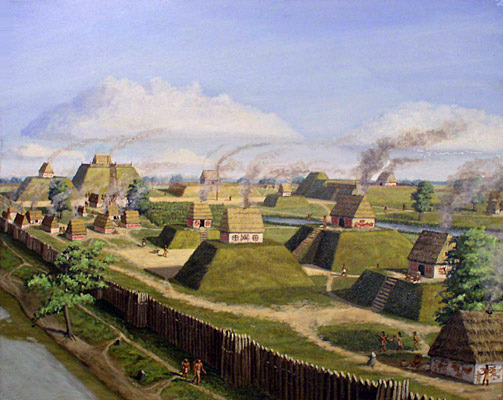
 So in any case, that's not the end of my adventures from this weekend. In between viewing the giant snow goose flock at Emiquon, trying to photograph ducks from a moving car, and chasing Eurasian Tree Sparrows, mom and I decided to stop by the Dickson Mounds Museum.
I must admit, I didn't really know much about Dickson Mounds prior to visiting. All I really knew beforehand was that it consisted of some old Native American burial grounds, which were built hundreds of years ago, forgotten, and later discovered by a man named Dickson.
In 1927, after purchasing a tract of land along the Illinois River, Dr. Don F. Dickson just so happened to stumble upon a series of burial mounds from an ancient Native American society. He soon began excavating, but instead of removing the bones and other artifacts from their graves, he left them intact, transforming the place into a private museum of sorts. Tourists, scholars, and archeologists came from all over the world to interpret Dickson's findings, and eventually, by 1945, Dickson sold his museum to the state of Illinois, which has maintained it ever since.
So, yeah... I kind of learned this from browsing the Dickson Mounds website, but one thing that I almost certainly had no prior knowledge of was the society that actually built the mounds.
When we picture Native Americans, we tend to think of them as nomadic hunter-gathers who lived in tribal communities, worshipped nature, occaisionally went to war with other tribes, and were eventually destroyed by the Europeans. And while we do acknowledge that the Native Americans were here "first", we rarely seem to take their 10,000-year history into account- from the crossing of the Bering Land Bridge up to the present day. While our textbooks may have entire chapters devoted to ancient Egyptian society, the sections describing Native American history seem consistently vague about the societies, languages, and religious beliefs that evolved during that enormous span of time. It's almost as if there's a giant, 10,000-year gap in history...but why?
I know for one thing that the North American Indians never really "built" much in comparison to other native societies, such as the Aztecs and Incas. There are no great big temples of stone in New Jersey, and certainly not in Nebraska, but there are these burial mounds in some parts of the midwest. Dickson Mounds is one of these places, and contrary to what I've always believed about Illinois history (that it hardly dates back further than the 1800's), native "mound-building peoples" had actually built thriving, sedentary societies as early as the 11th century- complete with temples, walled cities, population centers and trade-based economies!
According archaeologists at the museum, these Mississippian societies flourished during the first half of the millenia, but eventually fell into decline as they went to war with each other and contracted diseases. When Europeans colonized Illinois, most of the mound-builders had already evicted, and for the few that still remained, European conquest dealt the final blow.
I find it disappointing that we hardly spend any time learning about the ancient cultures of our region- and even worse how we rarely imagine them as little more than primitive, nature-worshipping teepee-dwellers. I glanced over my World History textbook from freshman year and noticed that the mound-builders are only mentioned in a single paragraph. I mean- really, what's the deal? Why don't we learn more about them?
In a sense, it all boils down to New Historicism- the idea that all writing is a product of its time. The Europeans who encountered native societies in all their intact glory found them inferior. When they initially encountered the remnants of mound-building societies, they actually refused to believe that the mounds were built by Native Americans. They didn't believe that such primitive, inferior people were "capable" of building these things. And since the Europeans were the ones who eventually wiped out the native populations, their writings- which offer us a glimpse into intact native societies- were probably biased to the point of being innaccurate.


 <----- :(