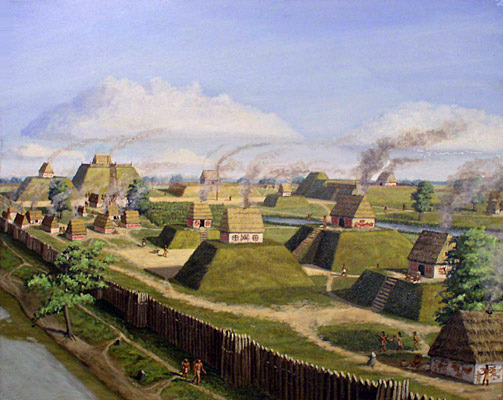
 So in any case, that's not the end of my adventures from this weekend. In between viewing the giant snow goose flock at Emiquon, trying to photograph ducks from a moving car, and chasing Eurasian Tree Sparrows, mom and I decided to stop by the Dickson Mounds Museum.
I must admit, I didn't really know much about Dickson Mounds prior to visiting. All I really knew beforehand was that it consisted of some old Native American burial grounds, which were built hundreds of years ago, forgotten, and later discovered by a man named Dickson.
In 1927, after purchasing a tract of land along the Illinois River, Dr. Don F. Dickson just so happened to stumble upon a series of burial mounds from an ancient Native American society. He soon began excavating, but instead of removing the bones and other artifacts from their graves, he left them intact, transforming the place into a private museum of sorts. Tourists, scholars, and archeologists came from all over the world to interpret Dickson's findings, and eventually, by 1945, Dickson sold his museum to the state of Illinois, which has maintained it ever since.
So, yeah... I kind of learned this from browsing the Dickson Mounds website, but one thing that I almost certainly had no prior knowledge of was the society that actually built the mounds.
When we picture Native Americans, we tend to think of them as nomadic hunter-gathers who lived in tribal communities, worshipped nature, occaisionally went to war with other tribes, and were eventually destroyed by the Europeans. And while we do acknowledge that the Native Americans were here "first", we rarely seem to take their 10,000-year history into account- from the crossing of the Bering Land Bridge up to the present day. While our textbooks may have entire chapters devoted to ancient Egyptian society, the sections describing Native American history seem consistently vague about the societies, languages, and religious beliefs that evolved during that enormous span of time. It's almost as if there's a giant, 10,000-year gap in history...but why?
I know for one thing that the North American Indians never really "built" much in comparison to other native societies, such as the Aztecs and Incas. There are no great big temples of stone in New Jersey, and certainly not in Nebraska, but there are these burial mounds in some parts of the midwest. Dickson Mounds is one of these places, and contrary to what I've always believed about Illinois history (that it hardly dates back further than the 1800's), native "mound-building peoples" had actually built thriving, sedentary societies as early as the 11th century- complete with temples, walled cities, population centers and trade-based economies!
According archaeologists at the museum, these Mississippian societies flourished during the first half of the millenia, but eventually fell into decline as they went to war with each other and contracted diseases. When Europeans colonized Illinois, most of the mound-builders had already evicted, and for the few that still remained, European conquest dealt the final blow.
I find it disappointing that we hardly spend any time learning about the ancient cultures of our region- and even worse how we rarely imagine them as little more than primitive, nature-worshipping teepee-dwellers. I glanced over my World History textbook from freshman year and noticed that the mound-builders are only mentioned in a single paragraph. I mean- really, what's the deal? Why don't we learn more about them?
In a sense, it all boils down to New Historicism- the idea that all writing is a product of its time. The Europeans who encountered native societies in all their intact glory found them inferior. When they initially encountered the remnants of mound-building societies, they actually refused to believe that the mounds were built by Native Americans. They didn't believe that such primitive, inferior people were "capable" of building these things. And since the Europeans were the ones who eventually wiped out the native populations, their writings- which offer us a glimpse into intact native societies- were probably biased to the point of being innaccurate.

A revelation about the real Americans that we know so little about. It makes one wonder why people are so anxious to go abroad when there is much to see and learn about our country.And learn why the mound societies disappeared.
ReplyDeleteAs a retired history teacher, I was quite fascinated by your comments and information. First, I confess to knowing nothing about the Dickson Mounds. Not only did I find the information most interesting but I appreciated your questions about why we are taught so little about Naive Americans and why there is such a huge gap in our knowledge. I think that you hit on some reasons - history is biased and presented from a particular point of view. In this case, the Europeans and then the colonizers (not Native Americans, of course) felt themselves superior. Fortunately, we do have some very good scholars and museums that strive to redress this terrible imbalance. We are all the poorer for not knowing about the rich cultures and accomplishments of people different than us. Next time in NY, we should try to see the National Museum of the American Indian.
ReplyDeleteAri, you answer your own question, and you do it well. If the Native Americans of the Midwest do not rank a better place in our historical and anthropological texts, it is not because of any willful neglect. It is indeed a result of the prevailing popular and scientific interests of the times. When I learned about the American Indians, the fascinating aspects of their culture were all drawn from the Pacific (Northwest) Coast and the Southwest. Academic bias?? Hollywood money-makers?? Perhaps if we could discover (or invent?) some intriguing burial practices, relics, or trinkets we could then hope to put the Dickson Mounds more prominently on the map and into future textbooks.
ReplyDeleteFabulous post. It's incredible that the history books leave such a big gap in the story of Native Americans' experience. You're absolutely right that neo-American curricula tell a single story about what it means to be Native American, and your claim that European writings were "probably biased to the point of being inaccurate" rings too true. How do you propose correcting some of our misunderstandings?-- Kate H
ReplyDeleteHey everyone- thank you so much for your comments! I really appreciate them!
ReplyDeleteTo answer Gunther's question, I suppose there are some reasons why our media presents the indians of the west instead of eastern cultures.
Although this is just an assumption, the western indians seemed to suffer less than eastern ones because their land was less densely settled by colonists. Indeed, by the time settlers reached the western states, most easten native cultures were probably wiped out or broken up already. They were destroyed before people really learned to appreciate them.
Although no native societies really escaped the effects of European colonization, some of the most intact groups- even today- can be found in the regions you mentioned. My guess is that when Hollywood and textbooks came out, they drew their knowledge from whatever societies stil existed.
And to answer Kate's question:
ReplyDeleteYes, there seem to be alot of misunderstandings about native cultures- quite frankly, I'm not sure how we'd eliminate them. One thing that particularly kills me is how we all seem to "lump" native americans together and address them as one big homogenous group instead of unique tribes.
To most Americans (the nonnative ones), the Cheyenne, Cherokee, Shoshone, Seminole, Pueblo, and Comanche might as well be the same thing! Aside from generating all sorts of misdirected stereotypes towards specific groups, this kind of approach is like taking every European country and putting it all under one big label.
The thing is, it's difficult to eliminate misunderstandings like this. But I think raising awareness through museums and education is definitely a step in the right direction.